How an Indian State Legislative Assembly Replaced Paper-Based Governance With a Fully Digital Platform
Building a scalable microservices platform that moved 100% paper-based Assembly operations to digital in one year
How an Indian State Legislative Assembly Replaced Paper-Based Governance With a Fully Digital Platform
Building a scalable microservices platform that moved 100% paper-based Assembly operations to digital in one year
Last updated: May 26, 2026
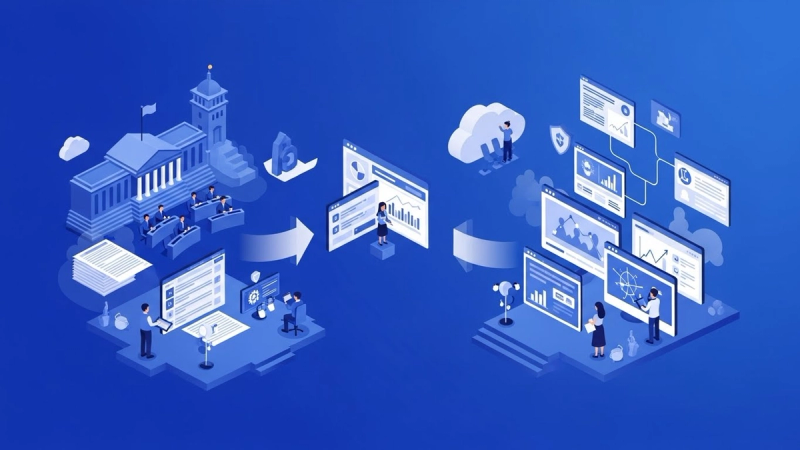
Outcomes at a Glance
100% paper-based workflows moved to digital
Complete transformation, no partial migration
Full platform delivered on schedule
Built and deployed in one year
Legacy monolithic system replaced
Scalable microservices architecture now in place
Projected: reduced manual effort across Assembly operations
Operational measurement ongoing post-deployment
About the Client
The Situation
Legislative assemblies run on process. Sessions have to be scheduled, agendas prepared, business documents routed, and records maintained, all while accommodating the procedural requirements that govern how a legislature operates. For the Assembly in this case, most of that work was still being done on paper, or through a patchwork of manual and semi-digital systems that had built up over the years without a consistent design.
A previous digital platform existed but had not solved the problem. It was built on a monolithic architecture that made it difficult to extend or integrate with other systems. Navigation was complex enough that staff and Members were not using it consistently. And because policy changes and staff transitions were frequent, the platform struggled to keep pace with shifting requirements.
The institution needed a full rebuild, not a patch: a platform that could handle the complete lifecycle of Assembly operations digitally, adopted in practice rather than in name only, and designed to grow as requirements changed.
The Impact
The cost of the paper-dependent setup was felt across the institution. Scheduling and agenda management required manual coordination across multiple teams. Official communications moved through physical routing rather than a tracked digital workflow, making it difficult for any stakeholder to know the current status of a process at a given moment. The sales team equivalent here, the Secretariat staff, spent significant time on administrative handling that a well-designed system could automate.
The existing platform made things harder rather than easier for many users, which meant staff were working around it rather than through it. The combination of low adoption and manual fallbacks meant the institution was carrying the overhead of both the digital system and the paper processes it was supposed to replace.
The Resolution
Edstem was engaged to design and build a replacement platform from the ground up, with a remit to digitise the full operational lifecycle of the Assembly.
The build started with the core before expanding outward. The "In-House" module, which manages sessions, schedules, and the flow of Assembly business, was developed first. Getting this right established the foundation the rest of the platform could be built on top of, rather than working around edge cases later.
The backend was designed as a microservices-inspired architecture to replace the old monolithic system. This approach means individual components can be updated, scaled, or replaced without affecting the rest of the platform, and new modules or integrations can be added without a rebuild.
The interface was designed with the actual user base in mind: Members, Secretariat staff, and administrative personnel with varying levels of technical familiarity. Reducing the learning curve was treated as a delivery requirement, not an afterthought, because adoption by real users was the measure of success.
The full platform was delivered in one year. The Assembly moved from 100% paper-based operations to a fully digital platform in that window. As deployment continues, the institution expects to see measurable reductions in manual processing time, better real-time visibility for staff and Members across active workflows, and a system that can accommodate future requirements without a new round of significant investment.
Working on a public sector digitisation project?
Edstem has experience building governance platforms that work in practice, not just on paper.
MORE CASE STUDIES